How to use alcohol markers on coloring pages
Alcohol markers give rich, flat color, but they soak through thin paper and streak if you hesitate. Move the slider to see how paper weight changes everything.
| Colored pencils | Works |
|---|---|
| Markers, brush pens | Bleeds through |
| Gel pens | Works |
Pick the right paper
Alcohol ink spreads into the fibers of the paper. On standard printer paper it shows through on the back and onto your table. Print on cardstock of at least 160 gsm (60 lb cover), and always slide a scrap sheet underneath.
Avoid streaks: work wet-on-wet
Streaks appear where wet ink meets dried ink. Color each shape in one go, with small overlapping circles, so the edges never dry before you reach them.
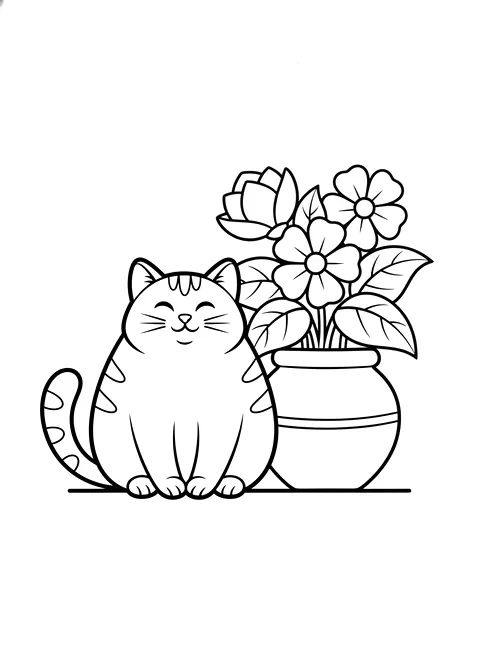
- 1Big shapes: work wet-on-wetColor the cat in one go with overlapping strokes before the ink dries, to avoid streaks.
- 2Flowers: lightest color firstMarkers are transparent: go light to dark, never the other way around.
- 3Pot: leave a highlightLeave a thin white line on one side. It instantly makes the pot look round.
- 4Stay inside thick linesBold outlines give you a safety margin: work up to the middle of the line, not past it.
Go from light to dark
Markers are transparent: a light color cannot cover a dark one. Lay the lightest shade first, then add shadows with a darker marker of the same family, and pull the light marker back over the edge to blend.
Bold pages are made for markers
Thick outlines give you a safety margin and big shapes are quick to fill. Start with bold and easy pages.
Step by step
- 1Print on cardstock. Use 160 gsm or heavier and put a scrap sheet underneath.
- 2Start with the lightest color. Fill each shape wet-on-wet in one pass.
- 3Add the shadow. Layer a darker marker of the same color family.
- 4Blend the edge. Go back over the transition with the lighter marker.
Questions
Why do my markers bleed through the paper?
The paper is too thin. Use cardstock of 160 gsm or more for alcohol markers.
How do I avoid streaks with markers?
Color each area in one go while the ink is wet, using small circles instead of long strokes.